
Finnish Design Trends 2026

Updated: Jan 31

Not Trends but a Return to What Endures
I don’t love the word trend when talking about Finnish design. Trends fade. Finnish design endures.
Still, I use the word here to describe something gentler: a collective return to values that have always been present.
Looking toward 2026, Finnish interiors are evolving in quiet ways, becoming warmer, richer, and more expressive, while staying rooted in function, longevity, and harmony with nature.
These are not predictions of what will be “in,” but observations of what is slowly, inevitably returning.
Harmony Over Minimalism
The era of extreme minimalism is gently receding. Not disappearing, but softening.
Finnish homes in 2026 favor visual calm with layered depth. Clean lines remain, but they are now accompanied by texture, material variation, and thoughtful detail. Instead of empty surfaces, we see intentional surfaces, spaces that feel lived-in, human, and emotionally grounding.
The goal is not austerity, but balance.
Material Honesty and the Rise of Expressive Stone
One of the most defining material directions of 2026 is the confident use of stone.
Striking stone surfaces—especially in kitchens and bathrooms are no longer limited to countertops. The same material often continues into backsplashes, islands, waterfall edges, and even side panels, creating a cohesive and architectural feel.
This isn’t about excess.
It’s about material continuity and durability.
Stone’s popularity is driven not only by its visual presence, but also by its resilience in everyday life, a value Finns have always respected.
Bathrooms as Daily Retreats
In 2026, Finnish bathrooms are designed as spa-like sanctuaries—spaces that support wellbeing, slowness, and restoration. Luxury here doesn’t mean opulence; it means thoughtful calm.
Smaller spaces are treated with even more care:
· Sculptural sinks
· Expressive stone vanities
· Rich, darker hues like forest green, deep brown, and earthy charcoal
· Carefully layered, atmospheric lighting
Every detail matters because every detail is felt.
Sustainability Through Longevity
In 2026, quality, durability, and material lifespan weigh heavily in decision-making. Long-lasting surfaces, responsibly produced materials, and reliable local manufacturing are valued not only ethically, but emotionally.
Supporting Finnish craftsmanship and local production isn’t seen as nostalgic—it’s seen as future-oriented.
Color: Soft Depth Over Stark Contrast
While Finns will always love a neutral palette, the palette is undeniably deepening.
The once-dominant black-and-white axis has expanded into nuanced, grounding hues:
· Forest greens
· Bark-like greys
· Muted terracotta
· Soft cocoa browns
· Warm, reddish beiges often referred to as kashmir
Inspired by forests, coastlines, and northern light, they pair effortlessly with natural wood and tactile materials.
Wood, Reimagined in Many Tones
Wood remains a cornerstone of Finnish interiors, but no longer in a single expression.
In 2026, we see:
· Walnut
· Smoked oak
· Deep brown stains
· Bold combinations of dark and light woods
Rather than uniformity, there is dialogue between tones. The result feels richer, warmer, and more architectural without losing its Nordic restraint.
Softness in Form: Curves Return
The desire for gentleness is visible not only in color, but in form.
Sharp corners are giving way to:
· Rounded island ends
· Oval tabletops
· Softer silhouettes
These shapes subtly change how spaces are experienced—making them feel safer, calmer, and more human.
Details as Personal Expression
After years of handle-less cabinetry, details are back.
Handles, faucets, fixtures, and hardware are once again celebrated as opportunities for personality. Warm metals, especially brass and nuanced metallic finishes, continue to resonate.
These are small elements, but in Finnish design, small choices carry meaning.

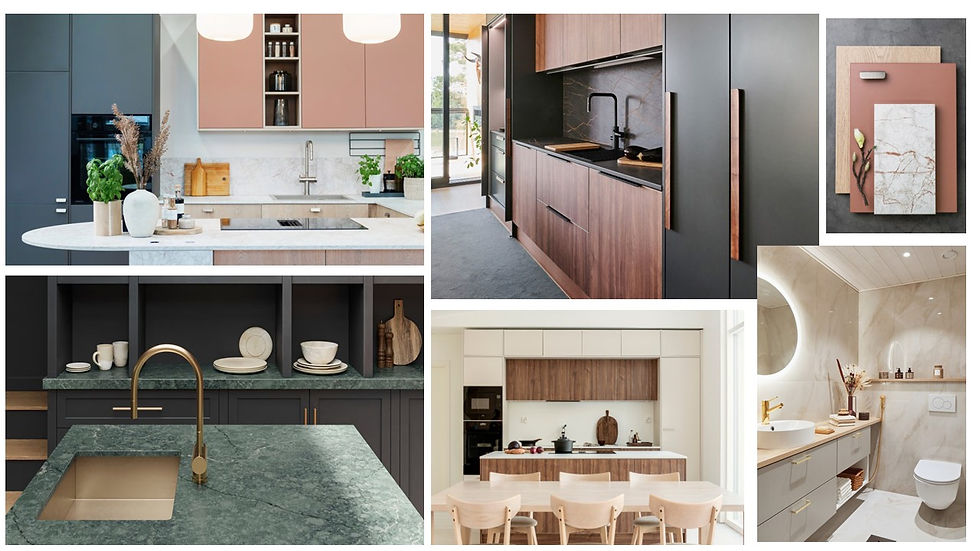
Photo Credits: Topi-Keittiöt, Tikkurila, umage design, AI, Cosentino


Comments